Talking wind
It looks like we could be in for some rough weather again over the next couple of days. The sites I look at (Windfinder and Poseidon System) are both showing the wind getting up to force seven with gusts to eight on Wednesday afternoon and overnight. They also show some rain on the way later in the week. Good for the water supply.
Village life
Wind is often a problem here, and I am not talking the aftereffects of a Greek salad and humus, I mean the άνεμος, the wind. But when I say ‘problem’ I probably mean annoyance. Yes, if the weather is harsh and particularly the wind, then the boats are not allowed to travel and that can mean no fresh supplies, no Rhodes visits, and basically not being able to get off the island until it dies down. But these things tend not to last for long and, as I always say, ‘Where there’s a will, there’s a relative.’ By which I mean, the wind issue is relative to your urgency. If you need hospital treatment like, right now, then other forms of transport are provided, assuming the helicopter can land and/or the coastguard boat can go – in an extreme emergency. Otherwise, you simply have to re-plan and make do. And the winds tend to be more amenable in the summer and it’s very rare that anyone misses a flight from Rhodes because if it. Anyway, back to άνεμος.
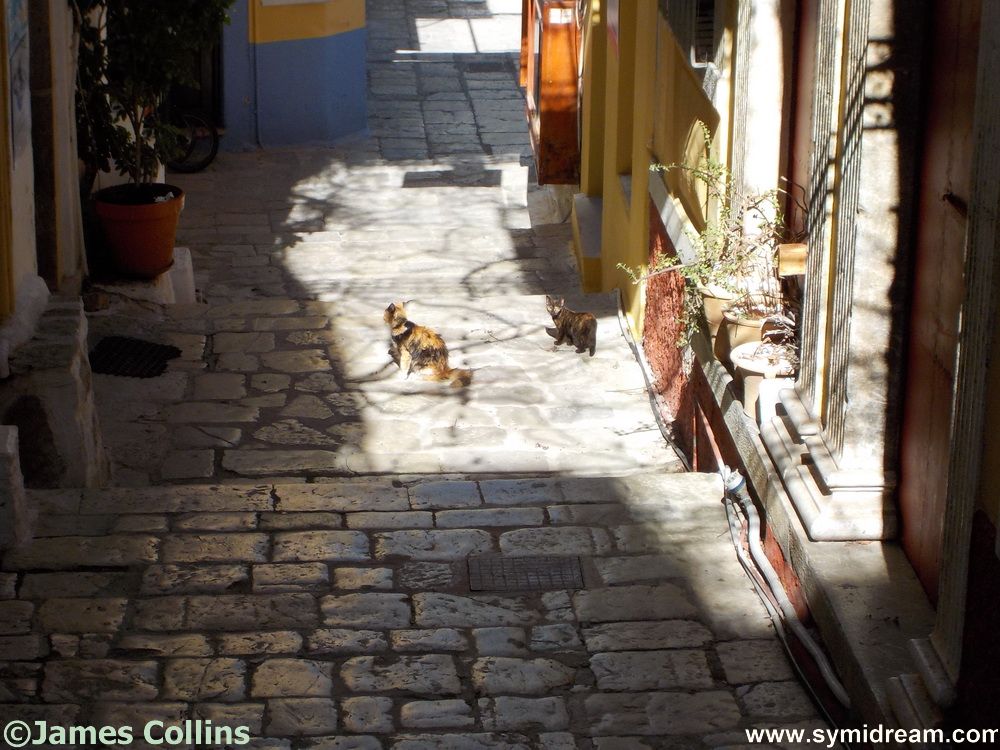
Village shadows
The word, άνεμος, can be found in some English words as I am sure you know. Anemophilos, pollinated by the wind, from άνεμος and also φίλος, for friend. And also, anemometer, an instrument for measuring the wind. But I wonder about the word that comes between the two in my dictionary, anemone. A little research reveals that this word, which is a plant of the buttercup family and also an underwater animal, comes into English (in the 16th century) from the same word in Greek. An anemone or ανεμονε (with a couple of ancient Greek accent included that I can’t reproduce here) was a ‘wind flower’ so called because the petals were said to open only when the wind blew. Sweet.
Another Mousecatsle view
Well, the wind flowers might be up for a challenge if we do get they force seven or above tonight and tomorrow, there may not be any of them left standing. Let’s hope it turns out not to be as bad as forecast, as that’s what very often happens.
From Symi to Sacsayhuaman in 900 years
The Pontikokastro, or ‘Mousecastle’ in English remains something of a mystery. It is situated on the hill overlooking Yialos on one side and the Pedi valley on the other and is an ancient monument. But what was it? Over the years I have read a few Symi guide books and articles and a few theories have been expounded on its origin and use. A Neolithic stone circle, a commemoration of a great sea battle, the burial pace of King Nireus of Symi or simply an old enclosure for animals; perhaps even something to do with the windmills that stand nearby. Unless it were to be excavated (unlikely) I guess there’s no real way of knowing for sure. But what we do know for certain is that it is a good place to catch a view or two.
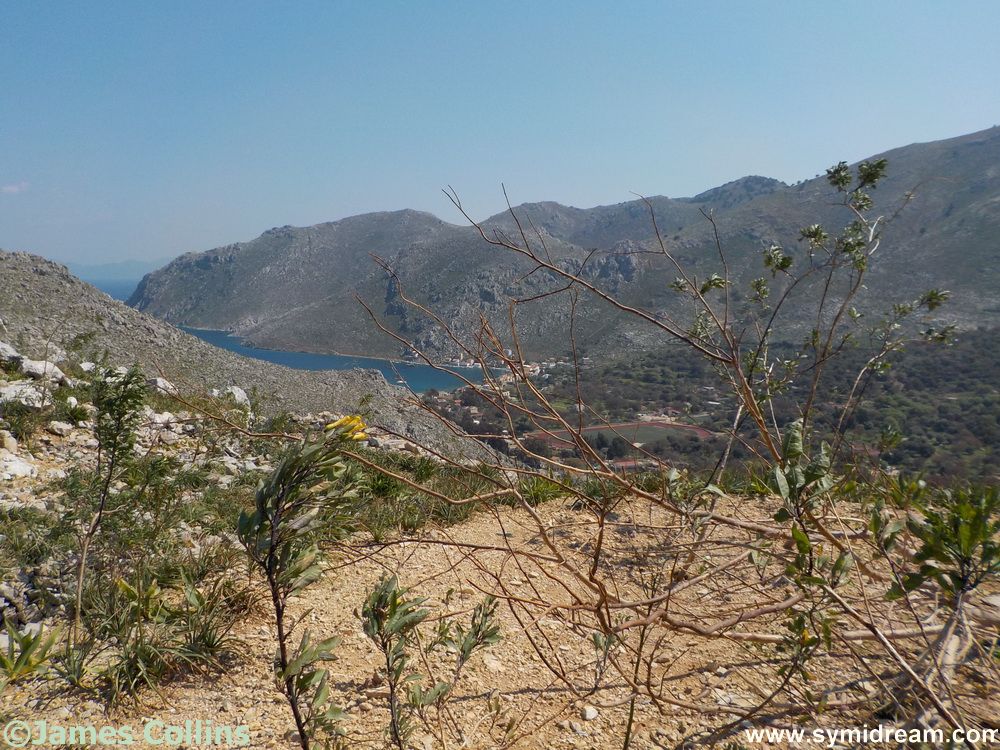
Looking towards the Pedi valley, still very green
Which is what we did on Sunday, briefly, while taking an afternoon walk. You catch the wind up there, hence the windmills nearby, and you certainly get good views: Down to Yialos and over to Nimos and Turkey on one side, and down into the valley and the further hills on the other, with the village laid out ahead of you and the rocky ridge heading towards Agia Marina behind you. You can stand on the top of it and see a full 360 degrees, though I don’t encourage you to stand on any ancient monuments! Walk around its base instead, it’s the same view. It’s a good place for an easy walk, the starting place for a longer walk over to Ag Maria (or a place to pass on the way back) and it’s really easy to get to. So, when you’re here on your Symi holiday, if you’ve not already seen it, and even if you have, you might like to wander up there, and here’s how:
Looking towards the village on the ridge of windmills
First, get to the village (bus, taxi, walk up) and then the Village Hotel and/or Windmill Restaurant. Follow the main road up the hill away from the village. This (allegedly) one-way street leads you to the crest of the hill where the road turns down to Yialos on one side and down towards Pedi on the other. It’s a T junction of sorts, by some bins and a discarded boat over the wall, and with the start of the main road path to Yialos (also worth a walk up or down one day). At this junction, you head straight across into a track with ruined windmills on one side, and you’re still going uphill. The path becomes stony, but not badly so and you will eventually come to a large gate. (There is also a viewpoint off to your left, look for the blue bench.) You can open the gate easily, and close it after you, and keep on up the rest of the slight hill and you can’t miss the Mouse Castle; the large, round collection of grey stones. Just be careful not to do any damage, it is eroding away slowly and doesn’t need our help.
Looking towards Yialos from the ‘mousecastle’
The formation of the stones in places (says he, knowing practically nothing about this kind of thing) reminds me of the work at locations such as Sacsayhuaman, above Cusco, Peru – which we were lucky enough to see in 2007 – in that they are tight-fitting and dressed. The Symi stones are maybe not as tight as those I have seen in Peru, which were put up around 1100, and some look like they were not dressed to fit at all. But there is no denying that this is a manmade structure with earth piled on top of it. I’m not sure if that was always there, if it has been filled in or whether there was any kind of roof to the structure at any point. By the way, the Neolithic period in south east Europe started around 7,000 BC, the period covers the last stage of the stone age and is, and I quote, “…significant for its megalithic architecture, spread of agricultural practices, and use of polished stone tools.” http://www.ancient.eu/Neolithic/
Sacsayhuaman – PeruSymi’s mousecastle stone cut-to-fit in a similar but not quite as polished way
Which brings me back to the original use of our Mouse Castle. Perhaps it was, after all, something purely for agricultural use. But then again, when you look out at the terracing on Symi you can never be too sure how old it is. Some thousand-year-old terraces are still being used, some have fallen and are virtually gone. If the Pontikokastro was built around the same time as, say, Sacsayhuaman (and the style of stone cutting looks remarkably similar) then there is no reason why it should not have survived for the last 900 years more or less intact. If it were simply an animal enclosure I would have thought that a) it wouldn’t be so well built and b) it would have gone the way of some terraces by now. It’s possible it was for lighting beacons, but again, a huge amount of work, stone cutting, moving and dressing have gone into it; surely too much for agriculture or a beacon. So, the mystery is still there, unless someone actually has evidence for what it was, and it remains a great place for a ponder and good view. Right, that’s my Archaeology note for today, now it’s back to Time Team on You Tube…
How it is to live in Greece – some books
I read an interesting article by my blog writing colleague, John P Manuel, on Sunday morning. In it he lays some fears to rest; fears by the ill-informed as to what is happening in Greece with the refugee crisis. He mentions some of the islands who have been at the frontline of this situation and explains a few things to those who would may have only have heard the wrong kind of news from television and print media. It’s well worth a read and this is the link: Ramblings From Rhodes.
Kali Strata Kats
And talking of fiction, as the title of the article does, John has also written a few books. Like me he has accounts of moving to and living in Greece, in this case Rhodes with his books Feta Compli, and his latest A Plethora of Posts – there are two others in this series as well, about life on a (larger) Greek island. Larger than Symi I mean. And then there are four novels including The View from Kleoboulosand A Brief Moment of Sunshine. You can find link to the full set of books via the blog site (see link above) or those individual ones by just clicking the titles. If you are interested in Greek living, living in Greece and what it’s really like to live on a Greek island (warts and all) then the books John writes will suit you down to your fustanella. And that is not a rude word, it’s a ‘skirt like garment’ (or kilt-like) to quote an online source, worn by several nations of the Balkans, and by Evzones, the Greek presidential guard.
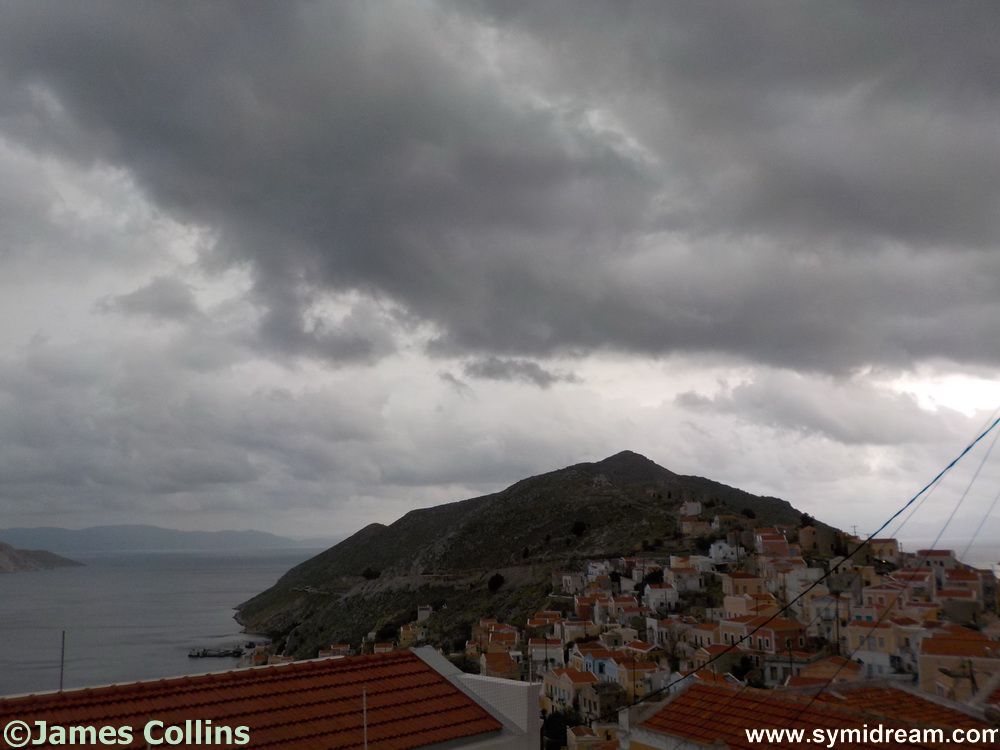
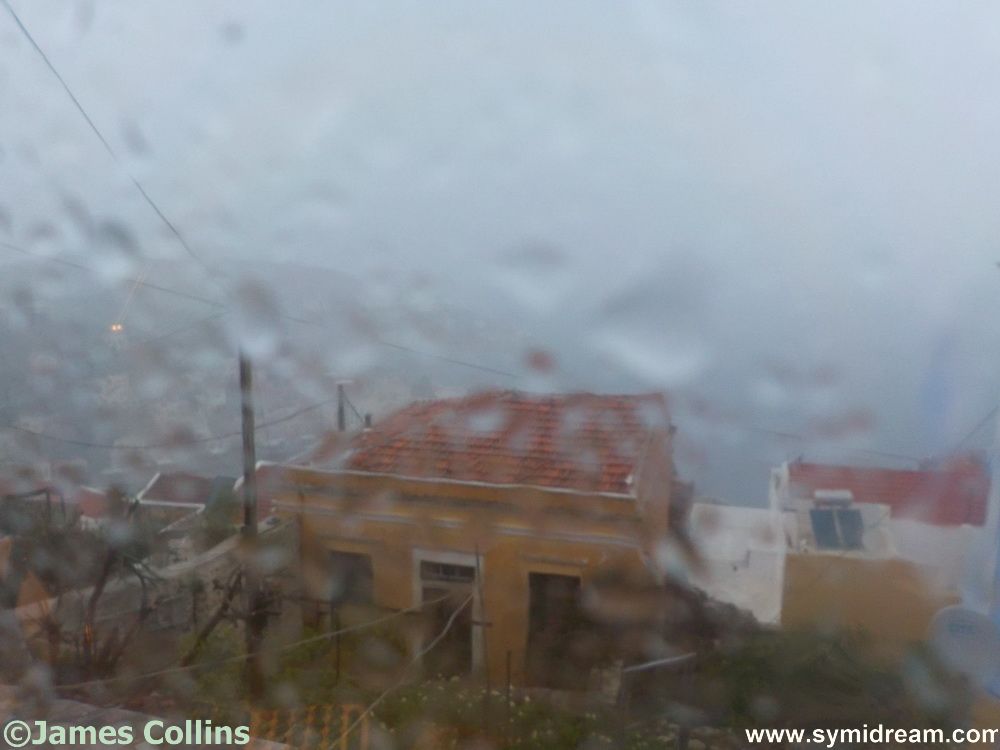
Meanwhile, if you were wondering about the weekend on Symi and what happened, well, the weather certainly happened. Saturday morning:
Saturday morningSaturday morning
Sunday morning:
Symi Sunday morningSunday morning
What a difference a day makes. The weather is good when it’s bad, at least it is if you want free water. We were able to fill up our sterna on Saturday morning, and it’s a pretty large one, which means we won’t have to buy any from the mains supply for a while. The plants also got a good watering and hopefully the reservoirs were topped up. Sunday however dawned clear and cold and bright, and so I grabbed a quick photo for you before writing this, posting it in advance and then getting on with my coursework. Today I have an assignment and that is to write a 300 word story, and then tell the story again three ways using three different story structures. And while I am doing that, Neil is in his room working on his IGCSE in Global Citizenship which, I have to say, is much more academic and much harder work than my writing course. He will also have to arrange to take the exam next year, perhaps having to travel back to the UK to do it, whereas I am purely correspondence. But we can look into all that at a later date. We may even be able to find some way that he can take the exam here in Greece.
Sunday morning
What I have looked into is the cover for ‘Remotely’ my next novel which is now with the editor, having been through the proofing stage. Mr Ed (as I just decided to call him) will work through it and lay it out while editing it down; helpfully I won’t get too much back for revisions. I am not expecting a fast turnaround on this one as Mr Ed is also dealing with a couple of films that he has produced and various other projects, but hopefully in the next couple of months, you should see it for sale.
And on that note: if anyone fancies promising me a review of the book on Amazon, I would he happy to send you a copy in advance. Then, when it’s published, you could put your review up on Amazon for me and hopefully attract more customers. I could send an electronic version in advance, or the Kindle version when that’s done. I wouldn’t be able to send hard copies until after publication date though. Drop me an email if you might be interested and we can talk further.
Wet weather again
We’re back to grey skies, some cold wind, and the promise of rain today. There are clouds rolling over the Turkish mountains, and they are looking pretty dark and thundery. So, for a change, I’m posting up a blog first thing in the morning and then going to the shops to get what’s needed for the day, before the rain starts. I will just nip out and open the tap to the sterna, so that I can collect as much rain water as possible.
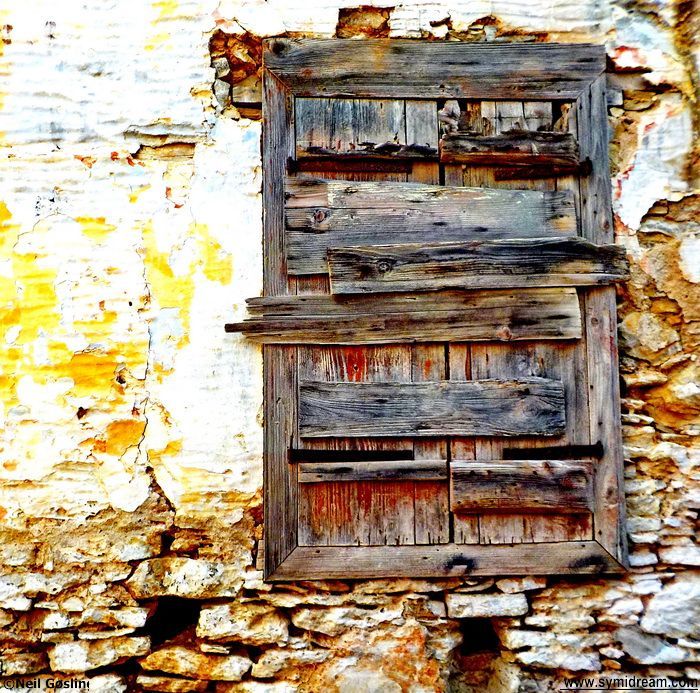
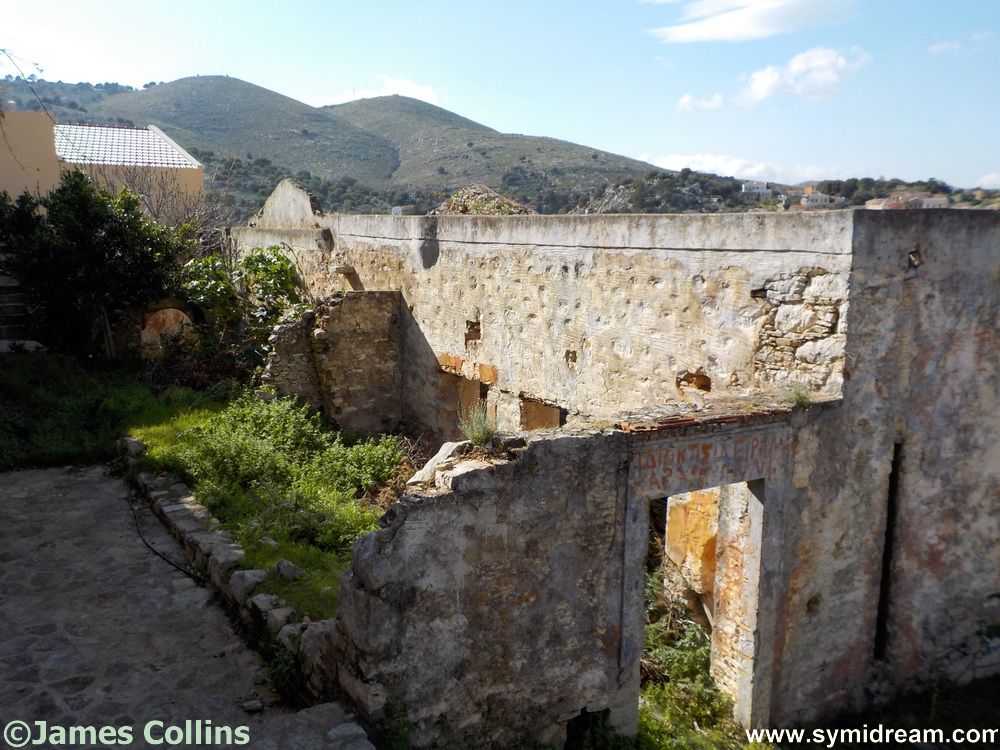
Colours of ruins
Okay, done that. What does the weekend hold in store? Well, by the looks of it from my window, a wet one for Symi generally, but here at the house… We have friends coming for lunch later, hence the need for speed and shopping, so there’s that to prepare and enjoy, and then… well, that’s it. It’s one of those no-planner weekends with nothing on the card apart from some coursework. This is for both of us. Neil is taking a qualification in Global Citizenship, and now has his course materials, and a lot of work ahead.
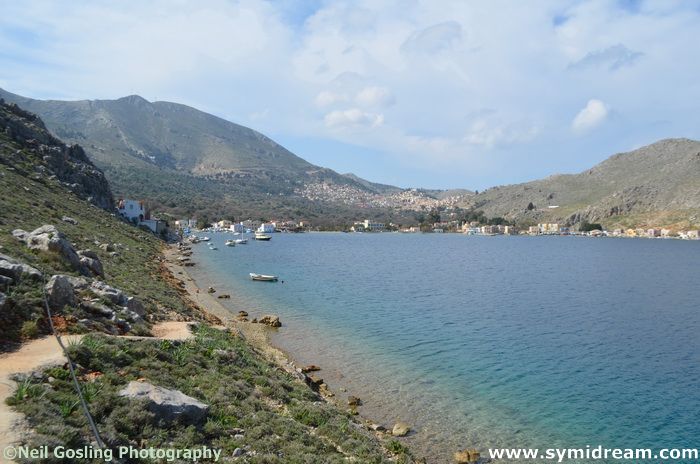
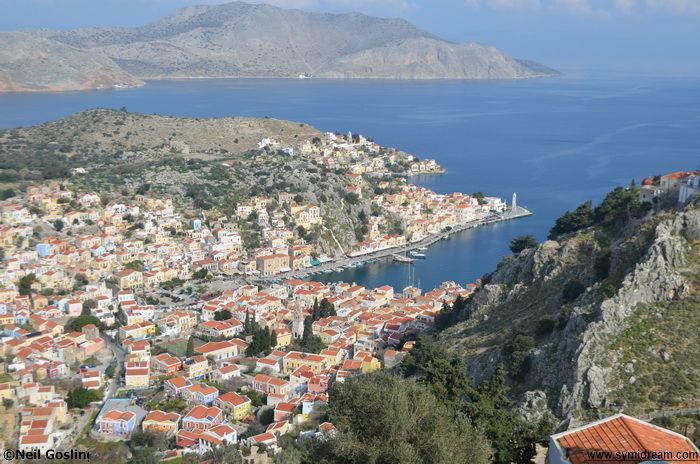
Pedi Bay
My next assignment is much simpler: I have to come up with a story, a real life event, and write it from four different points of view and in four different structures. Each ‘story’ is only 300 words long, so it’s not like popping out four novels or anything. I have a story in mind and aim to get it done and dusted by Sunday evening. That’s my weekend homework. But, if the weather clears up, I might go out for a walk as well. We headed down to Yialos yesterday to get some shopping and ended up sitting outside the kafeneion as it was so warm. That’s not going to be possible today, not unless you have a coat, umbrella and all the necessary gear to scale the South Col at Everest.
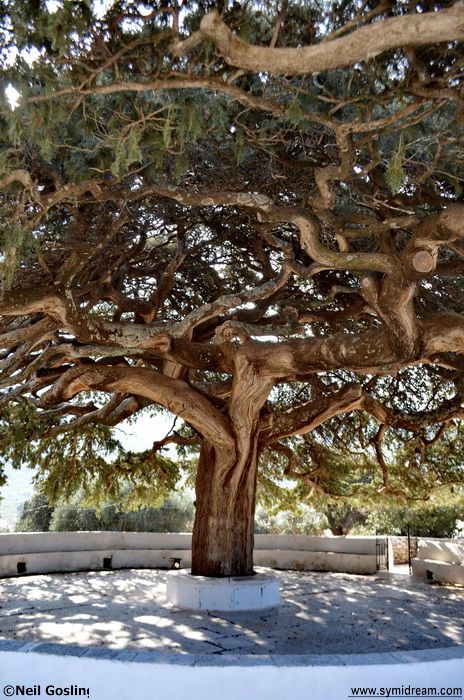
The well known tree at Roukouniotis
Actually, it’s not that cold, yesterday was colder, but it’s still not that pleasant, as it isn’t around here sometimes. But it will only be a matter of days before it’s back to normal and we’re all saying how warm it is. I hope. So, whatever you are going to do now: remember to share the blog, share the Symi news and our take on it, and have a good weekend.
Power cuts
Another thing that you might want to know about, especially if you were considering staying on Symi for any length of time; power cuts. I mention this because I am currently writing this in one, with my laptop on battery for a couple of hours; I will post it up later on when, hopefully, the power comes back on.
A view coming up an alternative steps/slope to the village
What causes them? Well, electricity not flowing through cables I guess. Why that happens though, I have no idea. I do know that it is not a problem at our house as the first thing you do when you are plunged into darkness is check the fuses. Actually, I was plunged into daylight this morning as the power went off at around 7.45 and it was light. That doesn’t help when you are researching online and have your writing stored up in the cloud. So, check the fuses and make sure they are all where they should be; up. If they are down, then there is a problem somewhere on one of your circuits. All up means the problem lays outside somewhere and outside your control. So what do you do?
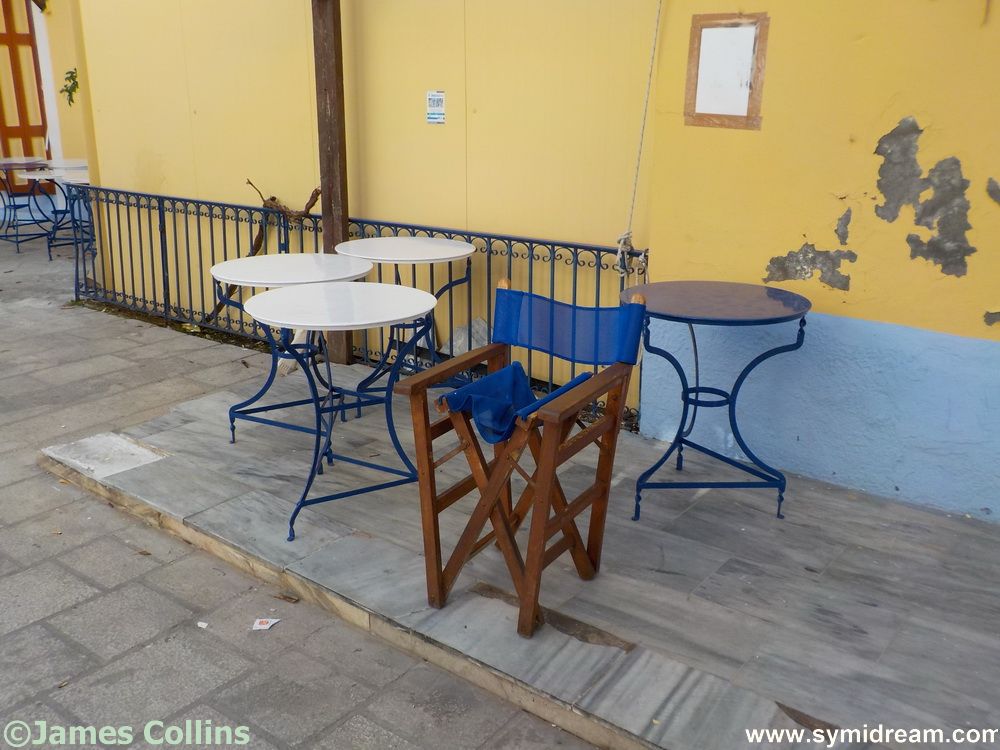
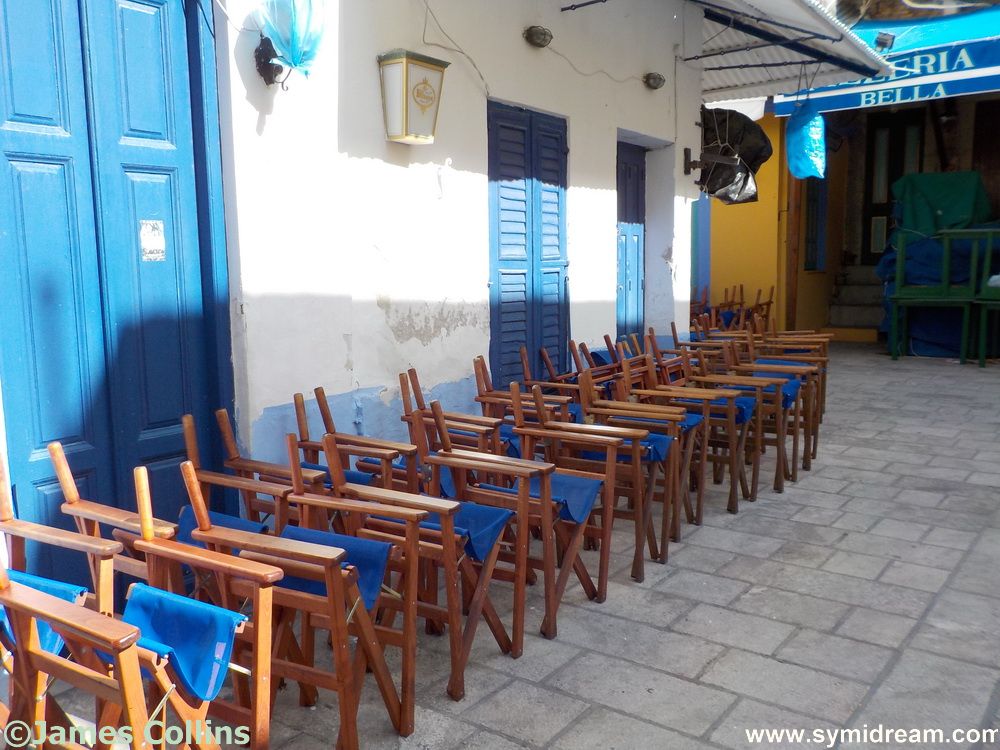
Preparing for the summer at Vapori Bar
Well, usually you ask your neighbours or send a text to a friend to see if they have power. That way you start to isolate the area affected. Sometimes it’s the whole island, other times, as was the case last week, it’s only a small area in your neighbourhood. Occasionally (and I’ve not heard this for a couple of years now) you get a warning, an announcement or, more likely, word of mouth around the village. Someone actually knows in advance when there is going to be a power cut so you can prepare. Today there was no warning, so I was not prepared.
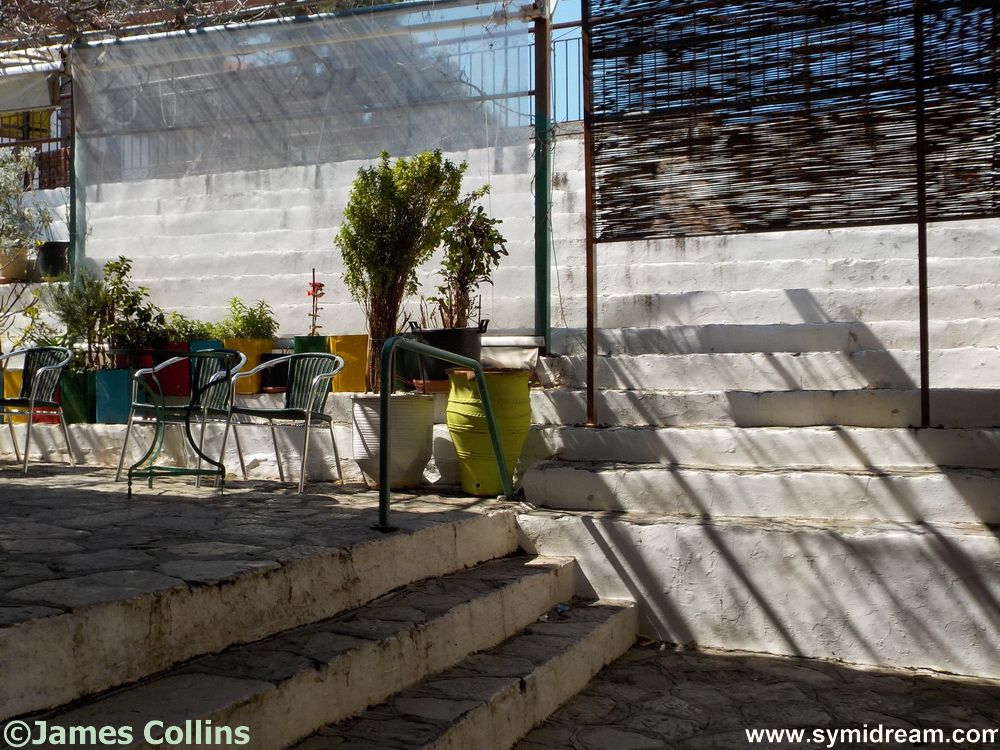
Getting the chairs ready
And now you are going to ask how do you prepare? Well, for a start you fill up water bottles with tap water so you can wash up, boil the kettle and flush the loo, though not all at the same time. You might also want to get a gas burner in if you don’t have one, so you can boil water. If you have an open fire you might want that ready – it’s not windy this morning but it is cold and there is no heating. And you may also want to get candles and torches ready for when it starts to get dark. We have candles in certain places and a torch always in the same place just in case.
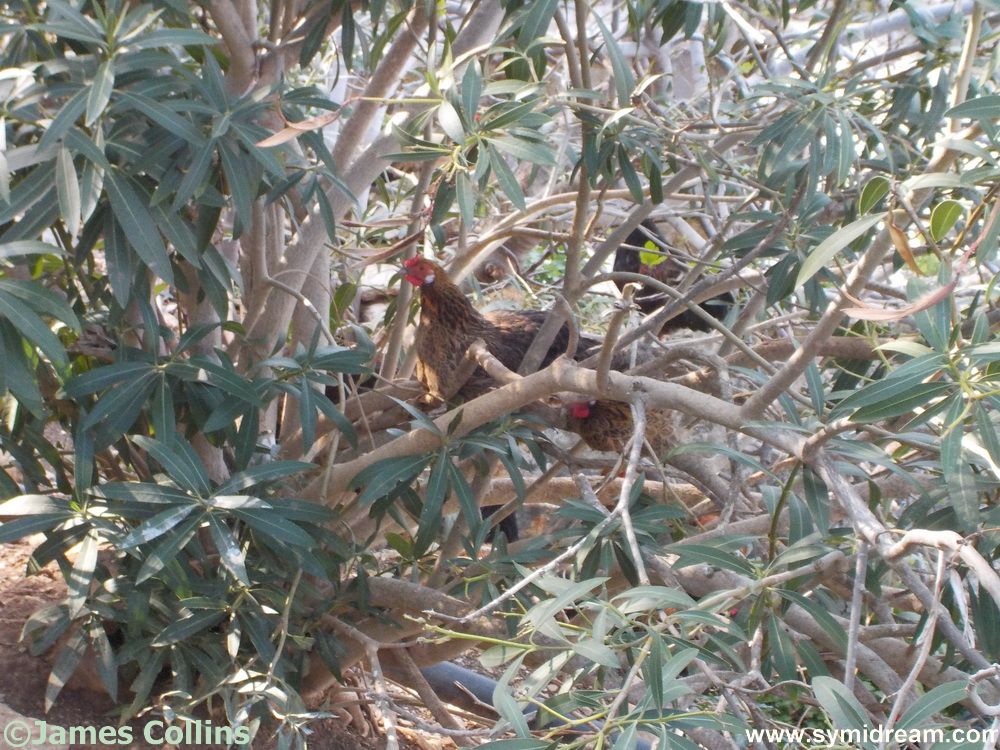
Local chickens in their tree again
And so what do you do when there’s no power and you can’t use your computer (for long) or have no internet connection? Imagine the horror of it for some: they wouldn’t be able to sit staring at their phones all day checking Facebook every 30 seconds in case something has changed, wasting hours of their lives seeing who had what for breakfast and how a dog gets on so well with a cat, and how the whole world hates Donald Trump and yet keeps voting for him, and how the UK Prime Minister is a hypocrite, and yet someone still voted for him too and how… And no online games, no instant television, no films, no nothing. What do you do? (Hysteria mounting.) Well, I usually start with the housework and get jobs slated for later in the day, out of the way so that when it comes back on I can get back to my work without then having to do the chores later. Then there’s the courtyard to tidy up, litter tray to empty, bedroom to tidy, bed to make, floors to sweep, books to read, books to write (remember longhand?), coursework to do (ditto), there’s always something to dust and clean and if that all gets done and it’s still not back on, there’s always a long walk. Maybe to the electricity company to see what’s going on.
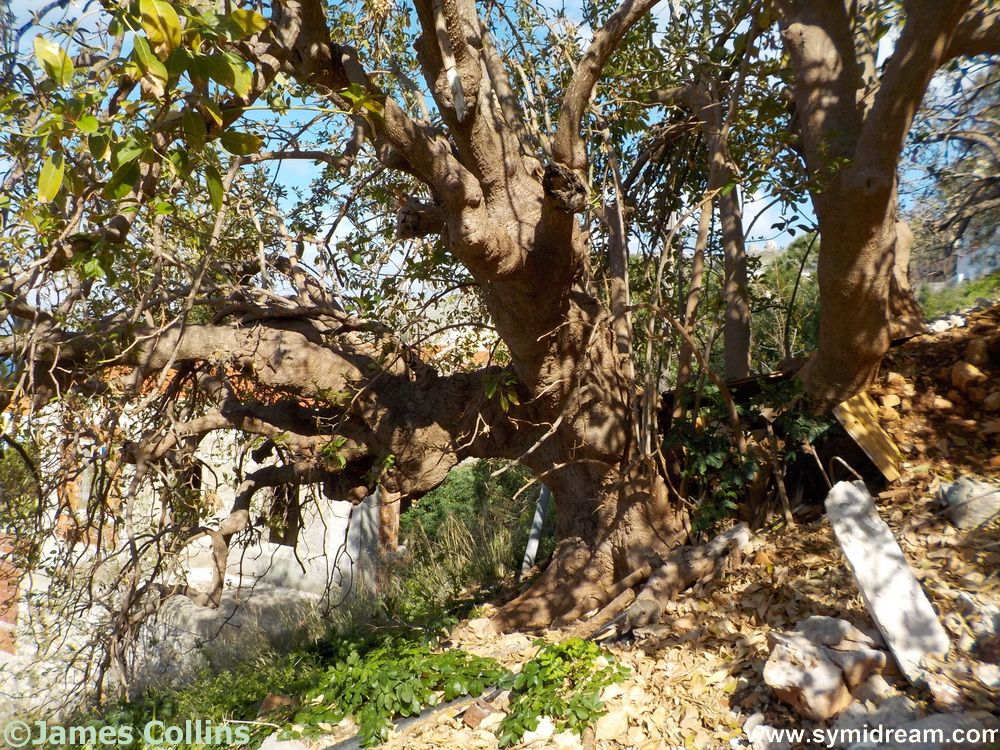
A large and probably old tree on the alternative way up to the village
And now I am going to check out some photos and load them up to go with this ramble and then go and set about the housework, once I’ve shouted across the lane to Andreas to ask if he has power at his house, just to be sure.